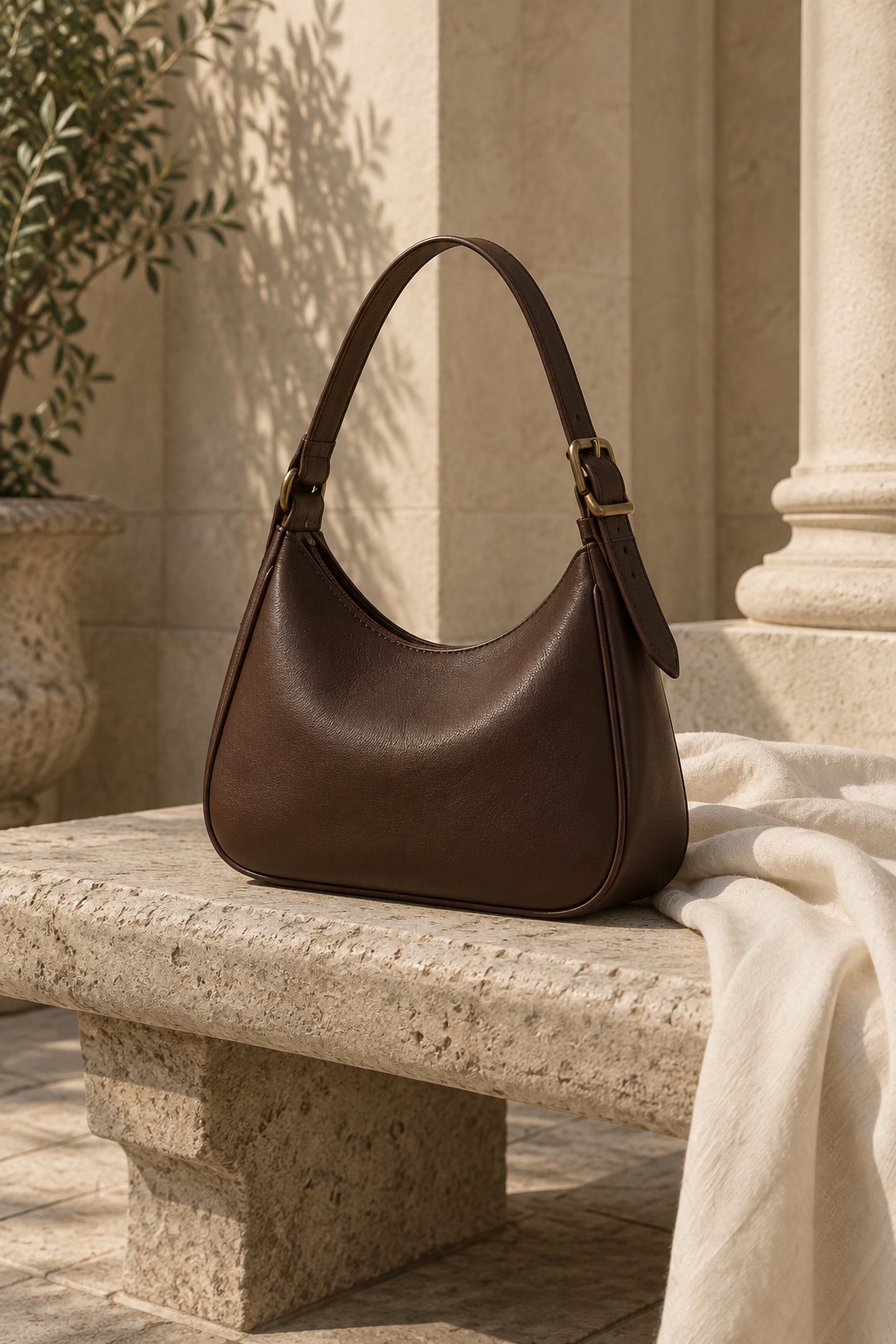
A handbag has to spend time with you. Its shape and color matter, but so do the things inside it, the way you carry it, and how often you need to reach for your phone or keys.
Begin with a bag you already use. What works? What irritates you? That gives you a more personal starting point than a list of supposed essentials.
Make an honest list of what you carry.
Lay out the items that travel with you on an ordinary day. Measure anything that determines the bag’s minimum size: a phone, glasses case, notebook, or tablet. Then compare those measurements with the retailer’s dimensions.
Outer dimensions do not describe the entire usable space. Consider the opening, internal divisions, lining, and shape. A narrow opening or a divided interior might make access awkward even when the overall measurements appear generous.
Think about how it sits on you.
Check strap drop and adjustability. A strap that works over a light dress may feel different over a coat. If you prefer a crossbody, look for the minimum and maximum strap lengths and consider where the bag will land.
Weight deserves attention too. When you can try a bag in person, ask whether you may test it with the things you normally carry. Notice whether the strap stays in place and whether the handle feels comfortable in your hand.
Inspect the details that do the work.
Look at the strap attachments, stitching, edge finishing, closure, and lining. Can you see how the bag opens? Is there a secure place for smaller items? Does the base hold the shape you want, or do you prefer a softer outline?
Read the material description and care guidance. Leather, coated fabric, and synthetic materials are broad categories with variations within them. A material name or designer label alone does not establish the quality of the finished bag. Avoid turning a single specification into a promise of durability.
Try it against three outfits.
Choose outfits you already wear, including at least one dress. Picture the size of the bag against each silhouette. A compact shape may sit comfortably with a full skirt; a larger bag might be exactly the contrast you enjoy with a simple column. These are experiments, not rules.
Look for color connections too. A handbag does not have to match everything exactly. It can repeat one color, provide a deliberate contrast, or introduce a texture. A color you wear often may serve you as well as a conventional neutral.
Choose the tradeoffs that suit you.
An open tote may give you easy access, while a secure closure may matter more during a crowded commute. A structured bag may keep its outline, while a softer one may feel easier against your body. More compartments can help you organize or limit how you pack.
The useful question is which arrangement fits your day. When function and appearance both make sense to you, the bag has a better reason to become part of your regular rotation.
Original editorial guidance from Dress Passions. No affiliate links appear in this article. Read our editorial and affiliate disclosure.
Back to the journal