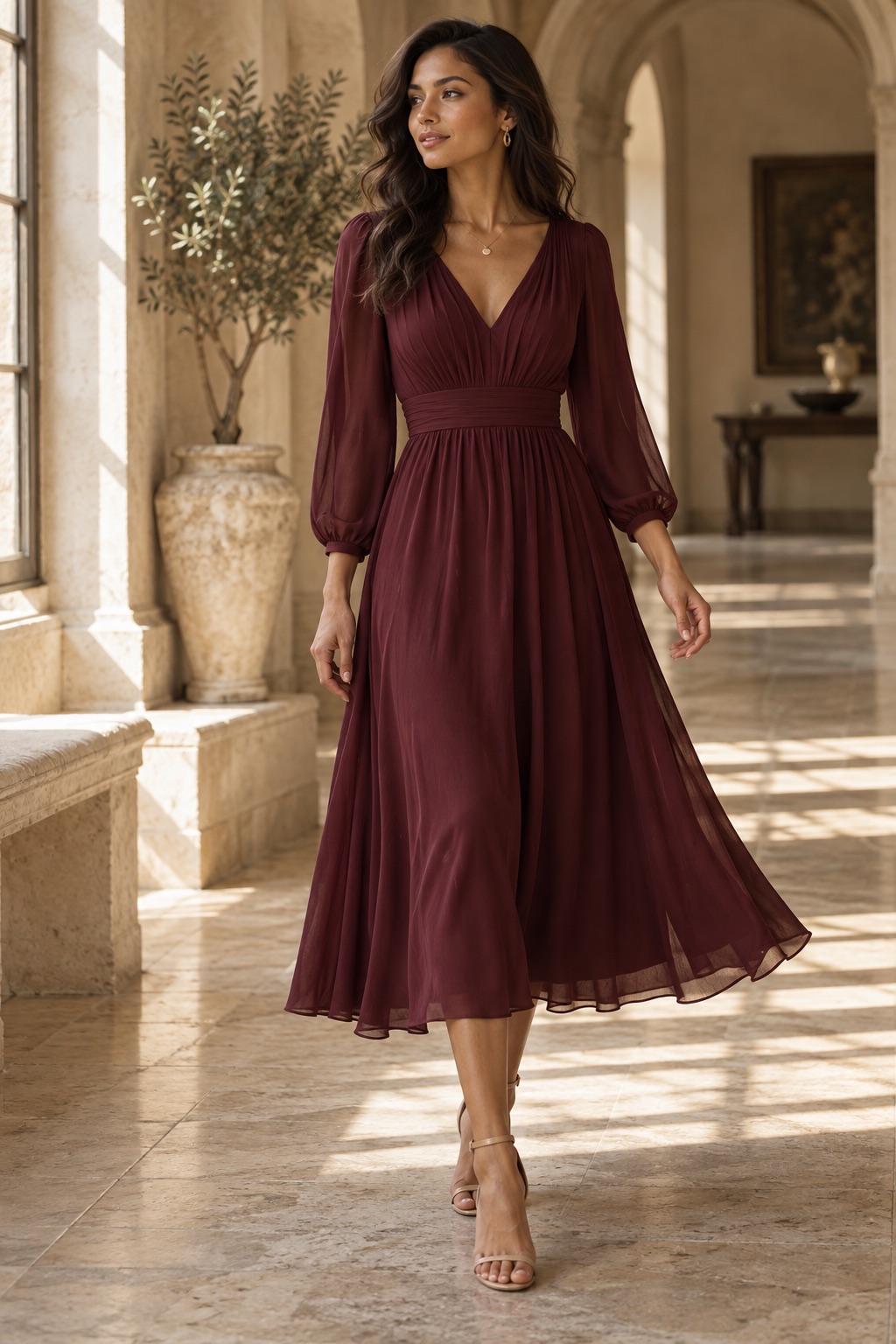
A dress can look convincing in one carefully styled photograph. Before deciding whether it belongs in your wardrobe, look for information that helps you imagine the whole garment: the back, the inside, the way it fastens, and how it behaves when you move.
Our starting point is quality, versatility, and accessorability. Those ideas become more useful when you turn them into specific questions.
Read the material description in full.
Look for the actual fiber composition rather than relying on a phrase such as “silky feel.” Check whether the lining is described separately. Material names are a starting point; they do not tell you the fabric’s weight, finish, opacity, or how the completed dress will feel on you.
Look at the care instructions before buying. A garment that needs a routine you do not want to maintain may get less use than you expect. Follow the instructions supplied for the actual item rather than assuming that every dress made from a particular fiber should be treated the same way.
Look at the construction.
Use close-up images to inspect seams, hems, buttonholes, and the fastening. Look for an even hang and details that meet cleanly. Ask for another image if an important area is hidden. A visible detail is a clue; photographs alone cannot establish how a garment will hold up over time.
When the dress arrives, examine the inside as well as the outside while keeping the retailer’s return conditions in mind. Check for loose threads, uncomfortable edges, and closures that are difficult to use. Notice whether the lining moves comfortably with the outer fabric.
Make fit a moving question.
Compare your measurements with the retailer’s chart for that item or brand. Check the stated length and where the waist seam is intended to sit. A size label by itself gives you less information than those measurements.
At a fitting, sit, walk, and reach. Notice whether buttons pull, straps slip, the neckline shifts, or the skirt restricts the movement you need. Think about the undergarments and layers you would actually wear with it. Comfort is part of deciding whether you will reach for the dress again.
Imagine at least two ways to wear it.
Picture the dress with a handbag you use often, then with a bag that changes the mood. Consider the neckline, waist detail, print, and skirt volume. Decide whether those details welcome different combinations or make the outfit feel more fixed.
A distinctive dress can still be adaptable. A strong print might work with several colors already in your wardrobe. A simple dress might have an unusual cut that limits the layers or bags you enjoy with it. Try the combinations rather than assuming.
Give yourself a reason beyond the photograph.
Before you buy, finish this sentence: “I would wear this to ___, with ___, and I like how ___.” The answer helps connect the purchase to your own life.
You may not be able to resolve every question online. Read the return policy, note any final-sale restrictions, and decide which uncertainties you are comfortable with before ordering.
Care-label reference: the Federal Trade Commission’s care-label guidance. This article offers general selection considerations, not laboratory testing or a review of a specific garment.
Original editorial guidance from Dress Passions. No affiliate links appear in this article. Read our editorial and affiliate disclosure.
Back to the journal